



Chemotaxis Assay Guide: Principles, Workflow, and Data Analysis
Chemotaxis is the directed migration of cells along a chemical gradient. It plays a central role in immune responses, inflammation, angiogenesis, wound healing, and cancer metastasis.
Chemotaxis assays determine whether cells migrate randomly or directionally in response to chemoattractants. Using live cell time-lapse imaging, these assays enable the observation and quantitative analysis of cell migration under defined and reproducible conditions.
This chemotaxis assay guide provides a structured overview from assay principles to experimental workflow and data analysis. Use the three main chapters below to understand chemotaxis, set up experiments, and analyze migration data from live cell time-lapse imaging.
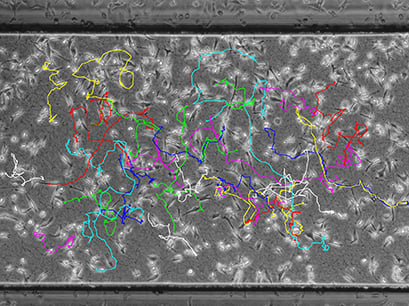
Tracked cell migration trajectories in a chemotaxis assay showing directed movement along a defined chemical gradient.
Chemotaxis Assay Topics: Principles, Workflow, and Data Analysis
Choose the chapter that matches your current question or experimental step. These three chapters cover the complete chemotaxis workflow from biological background to experimental setup and quantitative data interpretation.
Understand chemical gradients, directed migration, and differences between chemotaxis, chemokinesis, and other migration types.
Plan experiments, prepare samples, generate gradients, and perform long-term live cell time-lapse imaging.
Track cells and quantify migration using parameters such as velocity, directionality, and Forward Migration Index.
Chemotaxis Assays Explained: Quick Answers
| Question | Answer | Learn More |
|---|---|---|
| What is chemotaxis? | Chemotaxis is directed cell migration along a chemical gradient. | Principles |
| How does a chemotaxis assay work? | Cells are exposed to a defined chemoattractant gradient and tracked over time using live cell imaging. | Workflow |
| How is chemotaxis quantified? | Chemotaxis is quantified using parameters such as FMI, Center of Mass, velocity, and directness. | Analysis |
| Why is time-lapse imaging needed? | Chemotaxis is a dynamic process and requires cell tracking over time to measure directionality and migration speed. | Workflow |