




Three Outstanding PhD Researchers Honored with the Nano Innovation Award 2026
The LMU Center for NanoScience and four CeNS spin-off companies, including ibidi, recognize groundbreaking PhD research with exceptional innovation and translational potential.
>> Pressemitteilung auf Deutsch lesen
Munich, August 18, 2026–Single-molecule microscopy, AI-powered nanomedicine, and light-controlled DNA nanostructures: The Nano Innovation Award 2026, presented by the Center for NanoScience (CeNS) at LMU Munich together with four CeNS spin-off companies, honors three outstanding PhD projects that demonstrate both scientific excellence and strong application potential in nanoscience.
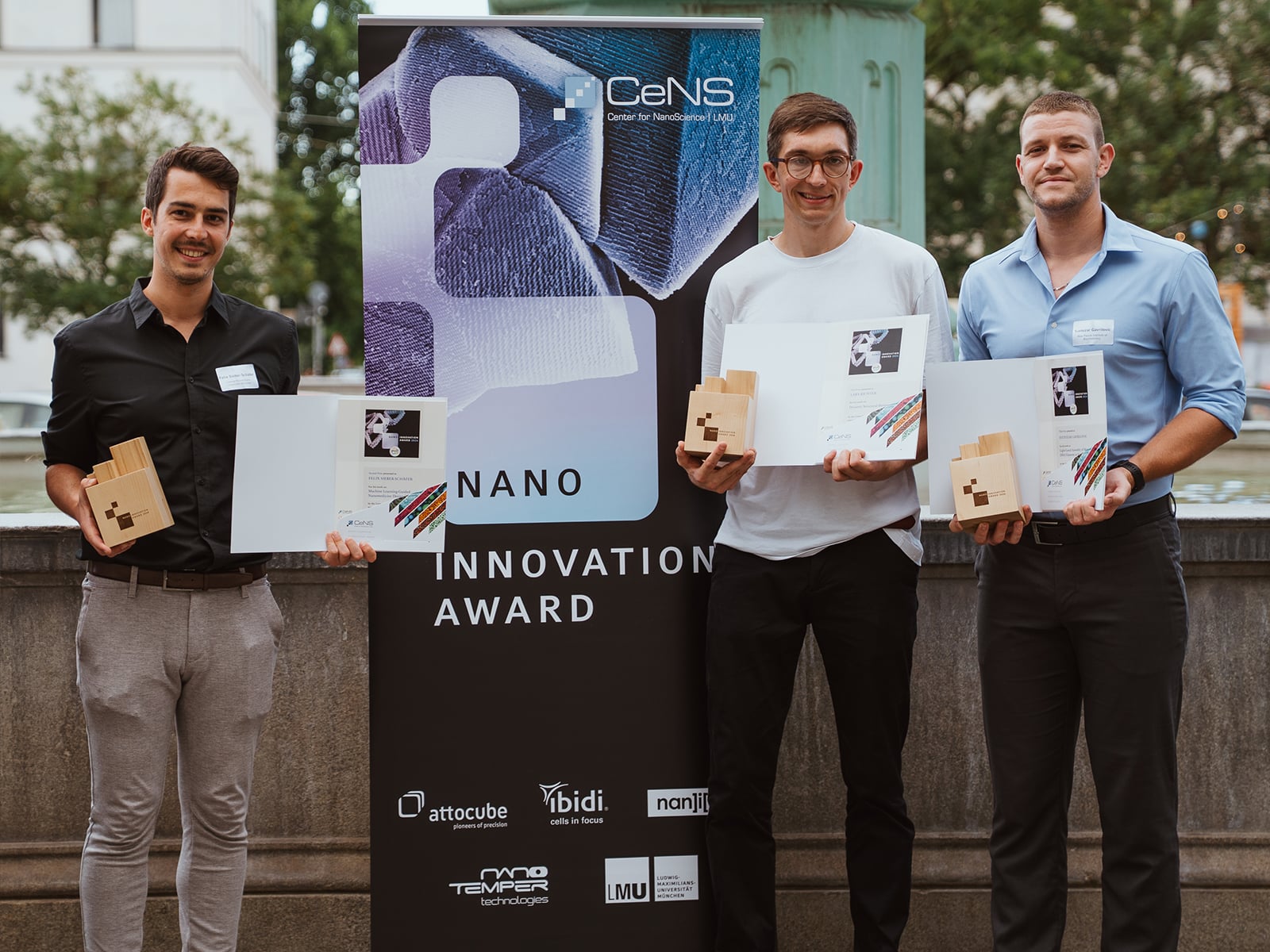
Winners of the Nano Innovation Award 2026
From left to right: Felix Sieber-Schäfer, Lars Richter, Svetozar Gavrilovic
This year's award recipients are Lars Richter (LMU Department of Chemistry), recognized for developing an innovative single-molecule microscopy approach; Felix Sieber-Schäfer (LMU Department of Pharmacy), honored for his AI-assisted design of RNA nanocarriers for therapeutic delivery; and Svetozar Gavrilovic (Max Planck Institute of Biochemistry), whose research focuses on light-controlled DNA structures for synthetic cell systems.
The CeNS Nano Innovation Award is presented annually to outstanding doctoral researchers in Bavaria whose work opens new avenues for addressing scientific and technological challenges. Beyond recognizing academic excellence, the award aims to encourage early-career scientists to identify and further develop the translational potential of their research.
Visualizing Biomolecular Dynamics at the Single-Molecule Level
As part of his doctoral research Dynamic Structural Biology with GETvNA, carried out in the research group of Professor Philip Tinnefeld, Lars Richter co-developed a novel single-molecule microscopy platform based on DNA nanotechnology. The method arranges DNA strands vertically on graphene,an atomically thin carbon material,and uses fluorescence measurements to monitor dynamic structural changes in DNA and DNA–protein complexes. This enables researchers to observe molecular motion and conformational changes with exceptional spatial and temporal resolution, providing new opportunities for studying fundamental biological processes.
Accelerating RNA Nanocarrier Design with Artificial Intelligence
In his PhD project Machine Learning-Enhanced Molecular Dynamics for the Prediction and Optimization of RNA Nanocarrier Systems, conducted in the research group of Professor Olivia Merkel, Felix Sieber-Schäfer developed data-driven strategies for designing RNA delivery systems. By integrating machine learning, molecular dynamics simulations, and experimental formulation studies, he established a more systematic approach for identifying promising lipid- and polymer-based nanoparticles. His work aims to replace time-consuming trial-and-error development with predictive, data-supported design, helping to accelerate the development of next-generation RNA therapeutics.
Light-Controlled DNA Assembly for Synthetic Cell Systems
Working in the research group of Professor Petra Schwille, Svetozar Gavrilovic developed a platform for the light-controlled assembly of DNA nanostructures on artificial membranes in his doctoral thesis Light-Gated Assembly of Membrane-Bound DNA Filaments as Synthetic Cell Modules. The approach employs DNA building blocks that become activated only upon exposure to UV light, allowing researchers to precisely control where and when DNA structures form. This technology provides a powerful tool for recreating and studying membrane-associated biological processes and could ultimately contribute to the development of synthetic cells and advanced biomimetic materials.
All three award recipients conduct their research within laboratories that are part of the CeNS network.
The Nano Innovation Award 2026 is presented by the Center for NanoScience (CeNS) in cooperation with the CeNS spin-offs attocube systems, ibidi, Nanion Technologies, and NanoTemper Technologies. The four companies sponsor prize money of €4,000, €3,000, and €2,000 for first, second, and third place, respectively.
The awards were presented on July 17, 2026, during the “CeNS meets Industry” career event at the Faculty of Physics, LMU Munich.
About ibidi GmbH – ibidi.com
ibidi GmbH, located in Gräfelfing near Munich, Germany, is a leading supplier of functional cell-based assays and products for cell microscopy. The ibidi portfolio includes innovative cell culture labware for high-resolution microscopy and cutting-edge cell-based assays (e.g. angiogenesis and migration). ibidi also specializes in instruments to provide physiological conditions during live-cell imaging (microscopy Stage Top Incubators) and a unique perfusion system (ibidi Pump System) for the simulation of blood vessels. To complete the ibidi product family, the company also offers reagents and extended solutions for 3D cell cultures.
About the Center for Nanoscience (CeNS)–www.cens.de
The Center for NanoScience (CeNS) is a scientific institution of LMU Munich that promotes and coordinates interdisciplinary research in the field of nanosciences. CeNS spans various disciplines such as physics, chemistry, biochemistry, and pharmacy. In addition to research groups from LMU, groups from TU Munich, the Max Planck Institute of Biochemistry, and other institutions in the Munich area also collaborate within CeNS.
For more information please contact:
Dr. Susanne Seifert
ibidi GmbH
Lochhamer Schlag 11
82166 Gräfelfing
Tel.: +49 89 520 46 17 34
ibidi.com
sseifert@ibidi.de
Dr. Susanne Hennig
Center for NanoScience (CeNS)
LMU München
Geschwister-Scholl-Platz 1
80539 München
Tel.: +49 89 2180 5791
www.cens.de
hennig@cens.de
Drei herausragende Promotionsarbeiten erhalten den Nano Innovation Award 2026
Das LMU Center for NanoScience und vier LMU-Spin-off-Unternehmen, darunter ibidi, prämieren erneut innovative Promotionsprojekte mit hohem Anwendungspotential.
München, 18. August 2026 - Einzelmolekülmikroskopie, KI-gestützte Nanomedizin und lichtsteuerbare DNA-Strukturen: Mit dem Nano Innovation Award 2026 hat das Center for NanoScience (CeNS) der LMU zusammen mit CeNS-Ausgründungen erneut anwendungsnahe Promotionsarbeiten aus der Nanotechnologie ausgezeichnet.
Die diesjährigen Preisträger sind Lars Richter (Department Chemie der LMU), ausgezeichnet für die Entwicklung einer neuartigen Einzelmolekül-Mikroskopiemethode, Felix Sieber-Schäfer (Department Pharmazie der LMU), geehrt für KI-gestützte Nanocarrier zum Transport therapeutischer RNA, sowie Svetozar Gavrilovic (Max-Planck-Institut für Biochemie), dessen Forschung sich auf lichtsteuerbare DNA-Strukturen konzentriert.
Gewinner des Nano Innovation Award 2026
Von links nach rechts: Felix Sieber-Schäfer, Lars Richter, Svetozar Gavrilovic
Der CeNS Nano Innovation Award würdigt jährlich innovative Promotionen mit Anwendungs- und Transferpotenzial im Bereich der Nanowissenschaften. Er richtet sich an Promovierende in Bayern, deren Arbeiten neue Lösungsansätze für aktuelle wissenschaftliche und technologische Herausforderungen eröffnen. Zugleich soll der Preis junge Wissenschaftlerinnen und Wissenschaftler schon in einer frühen Karrierephase ermutigen, das Anwendungspotenzial ihrer Forschung zu erkennen und weiterzuverfolgen.
Visualisierung Biomolekularer Dynamiken auf der Einzel-Molekül-Ebene
Preisträger Lars Richter entwickelte in seiner Forschungsarbeit in der Arbeitsgruppe von Professor Philip Tinnefeld eine Einzelmolekül-Mikroskopiemethode mit. Sie nutzt DNA-Nanotechnologie, um DNA-Stränge senkrecht auf Graphen, einer extrem dünnen Kohlenstoffschicht, anzuordnen. Über die Fluoreszenz eines Farbstoffs lässt sich messen, wie sich DNA oder DNA-Protein-Komplexe dynamisch verändern. So macht die Methode Bewegungen und Strukturänderungen von DNA mit sehr hoher räumlicher und zeitlicher Auflösung sichtbar.
Beschleunigung des Designs von RNA-Nanoträgern durch künstliche Intelligenz
Felix Sieber-Schäfer arbeitete in seiner Promotion in der Arbeitsgruppe von Professorin Olivia Merkel an datengetriebenen Methoden für die Entwicklung von RNA-Trägersystemen. Dabei verband er maschinelles Lernen, molekulardynamische Simulationen und experimentelle Formulierungsforschung, um geeignete lipid- und polymerbasierte Nanopartikel systematischer zu identifizieren. Ziel war es, RNA-Nanocarrier nicht mehr vor allem durch aufwendiges Ausprobieren, sondern mithilfe von Daten, Simulationen und Experimenten zu entwickeln.
Lichtgesteuerte DNA-Assemblierung für synthetische Zellsysteme
Svetozar Gavrilovic entwarf in seiner Doktorarbeit in der Arbeitsgruppe von Professorin Petra Schwille eine Plattform, mit der sich DNA-Strukturen durch Licht gezielt auf künstlichen Membranen aufbauen lassen. Dafür werden DNA-Bausteine verwendet, die erst durch UV-Licht an bestimmten Stellen aktiviert werden. So lässt sich steuern, wann und wo die Strukturen wachsen. Dies kann helfen, Vorgänge an Zellmembranen kontrolliert nachzubilden und besser zu verstehen. Langfristig könnten daraus Ansätze für künstliche Zellsysteme oder membranähnliche Materialien entstehen.
Alle drei Preisträger arbeiten in Forschungsgruppen, die dem CeNS-Netzwerk angehören. Der Nano Innovation Award 2026 wird vom CeNS in Kooperation mit den Firmen attocube systems, ibidi, Nanion Technologies und NanoTemper Technologies verliehen. Die vier CeNS-Ausgründungen stellen die Preisgelder in Höhe von 4.000, 3.000 und 2.000 Euro bereit.
Die Preise wurden am 17. Juli 2026 bei der Karriereveranstaltung „CeNS meets Industry“ an der Fakultät für Physik der LMU verliehen.
Über die ibidi GmbH – ibidi.com
Die ibidi GmbH, Gräfelfing bei München, ist ein führender Anbieter funktioneller zellbasierter Assays sowie von Produkten für die Zellmikroskopie. Die umfangreiche Reihe von Produkten bietet Lösungen für die klassische Zellkultur sowie für komplexe Assays wie z.B. 3D Zellkultur, Angiogenese, Chemotaxis oder Wundheilung. Durch die Produkte von ibidi wird das Verständnis von Entstehung und Behandlung unterschiedlicher Krankheiten erleichtert. Die Kunden von ibidi arbeiten weltweit in Forschungseinrichtungen, in der forschenden Pharmaindustrie und der Biotechnologie. Die Technologie von ibidi wird in zahlreichen BMBF-Projekten gefördert. Der Vertrieb der Produkte erfolgt weltweit.
Über das Center for NanoScience (CeNS) – www.cens.de
Das Center for NanoScience (CeNS) ist eine wissenschaftliche Einrichtung der LMU München, die interdisziplinäre Forschung auf dem Gebiet der Nanowissenschaften fördert und koordiniert. Dabei werden von CeNS verschiedene Disziplinen wie Physik, Chemie, Biochemie und Pharmazie überspannt. In CeNS kooperieren neben Arbeitsgruppen der LMU auch Gruppen der TU München, des Max-Planck-Instituts für Biochemie und anderer Institutionen im Münchner Raum.
Um weitere Informationen zu erhalten, kontaktieren Sie bitte:
Dr. Susanne Seifert
ibidi GmbH
Lochhamer Schlag 11
82166 Gräfelfing
Tel.: +49 89 520 46 17 34
ibidi.com
sseifert@ibidi.de
Dr. Susanne Hennig
Geschäftsführerin, Center for NanoScience (CeNS)
LMU München
Geschwister-Scholl-Platz 1
80539 München
Tel.: +49 89 2180 5791
www.cens.de
hennig@cens.de