




Chemotaxis Assay FAQs
This page answers common questions about chemotaxis assay setup, gradient formation, live cell imaging, cell tracking, data analysis, and troubleshooting when working with the µ-Slide Chemotaxis.
- Experimental Setup
- Imaging and Time-Lapse Microscopy
- Gradient Formation and Stability
- Data Analysis and Interpretation
- Chemotaxis and Migration Tool
- Troubleshooting and Protocol Questions
Experimental Setup
Which chemoattractant should be used as a positive control?
For establishing a positive control for a chemotaxis effect, we recommend using chemoattractants that have already been published with your cell type of interest, if available. If nothing is known, we advise using fetal calf serum for initializing a chemotaxis effect.
Which concentration of a chemoattractant should be used?
The concentration of a chemoattractant depends greatly on the used cell type and the experimental setting. For initial experiments, we recommend doing a literature research for the chemoattractant of interest, for example publications using Transwell assays. If no concentrations have been published, we advise screening a range of concentrations in 10-fold steps, for example 1 nM, 10 nM, 100 nM, and 1 µM, to identify the most effective chemotaxis result.
What is the recommended seeding density for non-adherent cells for a chemotaxis assay?
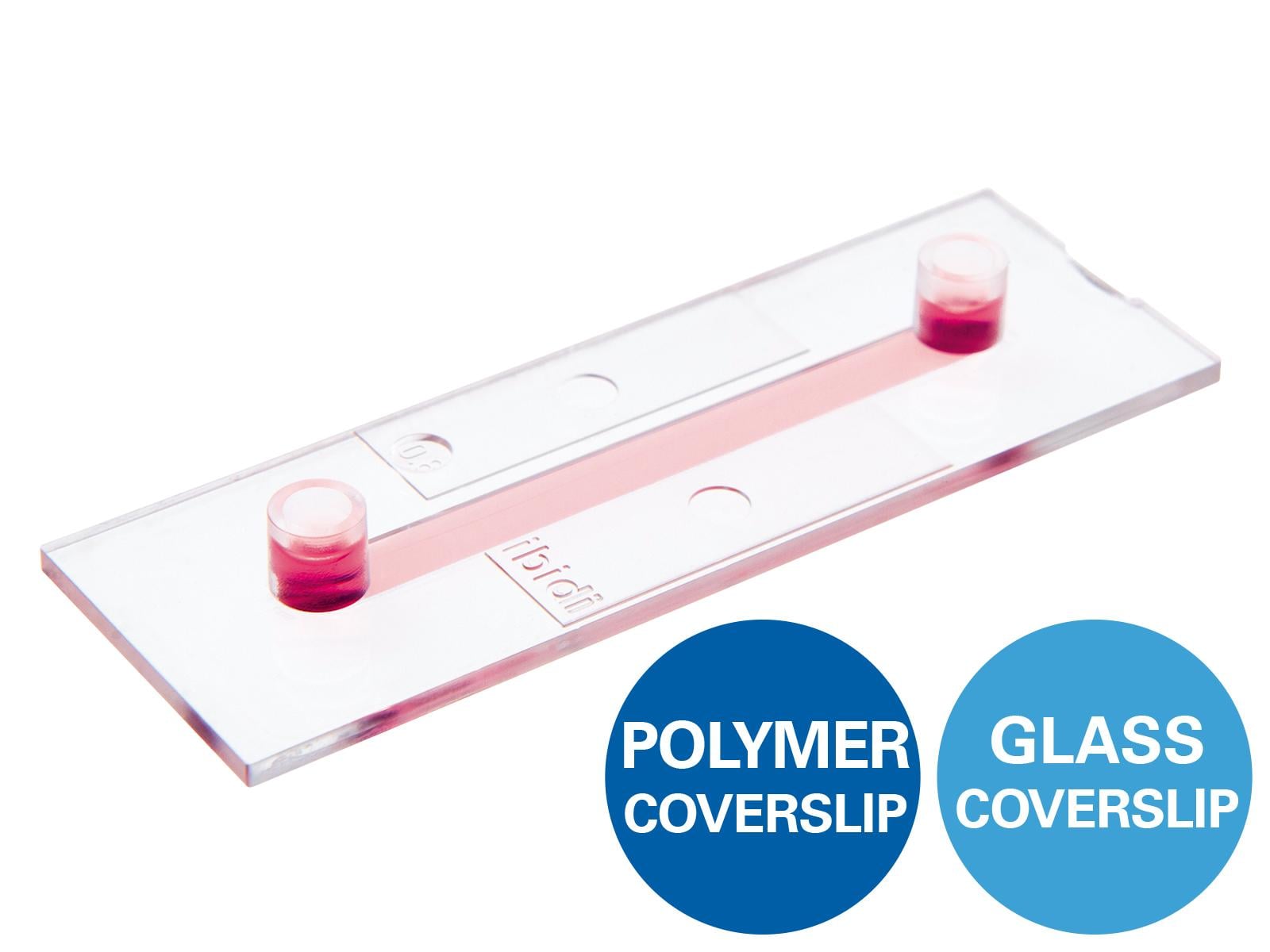
For each chamber of the µ-Slide Chemotaxis, we recommend seeding 6 µl cell suspension in a gel matrix with a concentration of 3 × 10⁶ cells/ml. Thus, the calculated number of cells per chamber is 18,000.
What is the recommended seeding density of adherent cells in a µ-Slide Chemotaxis to conduct a chemotaxis assay?
In order to get statistically significant data without overcrowding the observation area, ca. 200 cells should be present in the observation area of the µ-Slide Chemotaxis when starting the imaging. For more details on the cell concentration, please read Application Note 17.
Can 3D assays be used for non-adherent cells?
Yes. The mimicking of in vivo-like migration of non-adherent cells through interstitial tissue is a good argument for using gels in migration assays. We developed a protocol for investigating chemotactic migration of non-adherent dendritic cells in a Collagen I gel. Please refer to Application Note 23 for further details.
Is the ibiTreat surface of the µ-Slide Chemotaxis suitable for culturing HUVECs without coating?
HUVECs generally adhere well when using ibidi labware with the ibiTreat tissue culture-treated surface, especially when a growth medium containing 10% fetal calf serum is used. To speed up cell adhesion during chemotaxis assays, however, we recommend using µ-Slides Chemotaxis precoated with Collagen IV. Optionally, it is possible to coat the slides yourself by following the protocol in Application Note 08.
How can I do a fibronectin coating in the µ-Slide Chemotaxis?
Coating the µ-Slide Chemotaxis with fibronectin is easy. A general coating protocol can be found in Application Note 08.
Imaging and Time-Lapse Microscopy
Is imaging of chemotaxis assays only possible with an inverted microscope, or can an upright microscope also be used?
Using an inverted microscope is the most convenient method for imaging a chemotaxis experiment using the µ-Slide Chemotaxis. However, you can also use upright microscopes, but with this setup, the working distance of the objective needs to be at least 14 mm.
Why are video microscopy and cell tracking needed for the chemotaxis assay? Can’t I simply count migrated cells at the end of the experiment?
The ibidi chemotaxis assay is no endpoint assay. It is impossible to see or count the differences between start and end in a visual assay with homogeneous start conditions, because most cells migrate with low directness. Therefore, video microscopy and cell tracking are necessary.
Please find more information in the application chapter “Experimental Workflow of a Chemotaxis Assay”.
How long do I have to follow the cell migration with time-lapse microscopy?
We recommend observing the cell migration for at least 10 times the cell diameter. This is only a rough estimation, but you get representative trajectories. Shorter trajectories might not be representative, while much longer trajectories do not add more migratory information.
Example: HT-1080 cells are approximately 20–50 µm in diameter and their average speed is ca. 40 µm/hour. This means that after 10 hours, you get representative trajectories for most single cells in that population. In other words, most cells moved about 10 times their diameter.
Do you have a video or other material that illustrates how to use the µ-Slide Chemotaxis?
Please check out the following video for an overview on how to pipet the µ-Slide Chemotaxis: Chemotaxis Assays Using the µ-Slide Chemotaxis. Find more detailed information about the planning, procedure, and data analysis of chemotaxis assays here.
Gradient Formation and Stability
Does the gradient change during the chemotaxis experiment?
The gradient establishes within the first few hours after the chemoattractant has been added into the µ-Slide Chemotaxis. After that, an equilibrium is reached and the gradient does not change for the next 48 hours. After that, the gradient slowly flattens due to molecule transport across the observation area.
Please find an example of a gradient measurement on the µ-Slide Chemotaxis product page.
How stable is the gradient over time?
The ibidi µ-Slide Chemotaxis is designed to provide a quick gradient with excellent long-term stability for more than 48 hours. In 3D chemotaxis assays using aqueous gels, such as Collagen I or Matrigel®, the gradient is stably established and not influenced by the gel in any way.
Does the gel in the µ-Slide Chemotaxis affect the diffusion of chemoattractant molecules and thereby influence the gradient?
Typical aqueous gels, such as collagen gels or Matrigel®, do not interfere with diffusion of a chemoattractant molecule in the µ-Slide Chemotaxis. The pore sizes of the gels are too large to affect diffusing molecules. Whenever a gel matrix pore size is smaller than the diffusing molecules, diffusion will be impaired and a gradient will not be established in a regular way.
What is a gradient and how does it differ from a concentration profile in chemotaxis assays?
When performing chemotaxis assays, the terms gradient and concentration profile are often confused with each other.
A concentration profile describes the distribution of a concentration, for example of a specific compound or chemoattractant, over a certain distance. The gradient is the slope at one particular point of this concentration profile.
In a linear concentration profile, the gradient, or slope, is identical at all positions, whereas the absolute concentration changes along the distance. When there are no concentration differences, the gradient is 0.
In chemotaxis assays, cells respond to concentration differences of a chemoattractant rather than to the absolute concentration alone. Therefore, understanding the difference between the concentration profile and the gradient is important for interpreting directed cell migration.
For controlled and reproducible gradient generation, specialized systems such as the µ-Slide Chemotaxis can be used to establish stable and defined concentration profiles.
Data Analysis and Interpretation
How many cells should be tracked in one observation field?
Usually, it is sufficient to track 30–40 cells per observation field. However, when there is a weak chemotaxis effect, it might be necessary to track more cells to obtain statistical significance. For a strong chemotaxis effect, it might be sufficient to track fewer than 20 cells per condition.
Which data should be shown when presenting chemotaxis results?
Here are some recommendations for presenting the results in talks or publications:
- Show the original video, meaning the time-lapse film of your cells.
- Show the trajectory video, meaning the time-lapse film with overlaid cell trajectories from the tracking.
- Display the trajectory plot.
- Show the table or bar graph of the Center of Mass, FMI, and Rayleigh test.
How do I differentiate directed, chemotactic cell migration from undirected, random migration?
Please find detailed information about the data analysis and interpretation of chemotaxis assays in the application chapter “Data Analysis of Chemotaxis Assays”.
What is the purpose of the Rayleigh test when analyzing chemotaxis assays?
The Rayleigh test is a statistical test for the uniformity of a circular distribution of points, meaning cell endpoints.
With p < 0.05, the null hypothesis, uniformity, is rejected, indicating a chemotaxis effect. Like all statistical tests, this one strongly depends on the number of analyzed cells.
Moore BR., 1980, A modification of the Rayleigh test for vector data, Biometrika, Volume 67, 175–180.
What is the difference between the Rayleigh test and the Rayleigh test for vector data?
The Rayleigh test for vector data also includes the distance from the origin.
Why do all cell tracks start from one single point in the created plots when using the Chemotaxis and Migration Tool?
When using the Chemotaxis and Migration Tool, all coordinates of the cell trajectories are transformed for a better visualization when creating the plot: all start points are set from x, y to 0, 0. This is a common procedure in chemotaxis analysis. Of course, not all cells actually start from the very same point in the experiment.
Chemotaxis and Migration Tool
What is the difference between slice series and track series when using the Chemotaxis and Migration Tool?
When using the Chemotaxis and Migration Tool, slice series exports data from single slices, meaning time points. Track series exports data from different tracks, meaning cells. For example, Slice Series / Directness exports the parameter Directness of each time point, averaged. Track Series / Directness exports the parameter Directness of each cell.
Which image is used by the Chemotaxis and Migration Tool for calculating the p-value of the Rayleigh test?
The Chemotaxis and Migration Tool automatically uses the last image, meaning the cell endpoint, for calculating the p-value of the Rayleigh test.
How can I plot my chemotaxis data table when using the Chemotaxis and Migration Tool?
For a detailed description on how to plot chemotaxis data tables when using the Chemotaxis and Migration Tool, please refer to the Chemotaxis and Migration Tool Instructions.
Is an analysis with the Chemotaxis and Migration Tool possible when data points of the cell tracks are missing?
The Chemotaxis and Migration Tool software rejects all tracks with missing data points. Even if only one data point is missing, the track is not used. Therefore, please check that each track is complete, for example with Excel.
Which data format is needed for analyzing chemotaxis assays with the Chemotaxis and Migration Tool?
Before you can do a final analysis of your chemotaxis data with the Chemotaxis and Migration Tool, you need to track the cells using the acquired images or videos. The Chemotaxis and Migration Tool requires a tab-separated data table with tracks, slices, and x/y positions of the cells. This can be created by using Manual Tracking, an ImageJ plug-in.
Datasets from Manual Tracking can be imported directly into the Chemotaxis and Migration Tool software. For a detailed description, please refer to the Chemotaxis and Migration Tool Instructions.
To practice every step of the analysis, find Example Data of a Chemotaxis Assay.
Troubleshooting and Protocol Questions
My cells do not migrate. What can I do?
Cell migration is a very sensitive process, which is influenced by many factors such as the substrate, coating, as well as the medium and its supplements. If the cells migrate very slowly or do not migrate at all, we suggest trying different experimental conditions, changing only one condition at a time.
The migrating ability also depends strongly on the cell type, cell density, and passage, as all this can influence whether the cells are in a migratory or non-migratory state. In addition, some cell types need special stimuli or have to undergo differentiation before they are able to migrate. Before using a new cell type for a chemotaxis assay, a literature research on these factors is recommended.
If all the filling ports on the µ-Slide Chemotaxis chamber are plugged, is it still permeable to CO2 and other gases?
Yes, the polymer material of the µ-Slide Chemotaxis is still gas permeable, even after closing all filling ports with the plugs. This gas permeability, however, is low when the chamber is completely closed. This means that it will take quite a long time for the CO2 and O2 to seep into the liquid when the slide is inside the incubator. To avoid air bubbles, we recommend degassing all liquids and the slide before using them by placing them inside the incubator for 24 hours before starting the experiment.
Do you have any recommendations on how to avoid bubbles that appear after loading cells in the µ-Slide Chemotaxis?
The most common reason for air bubbles in the µ-Slide Chemotaxis is gas being released from the medium and the polymer, which is due to a temperature increase when the slide is placed in the incubator. To avoid this, we recommend degassing all liquids and the slide before using them by placing them inside the incubator for 24 hours before starting the experiment.
I often have trouble loading the observation chamber with the gel mix. How can I improve my method?
Please refer to the detailed troubleshooting section in Application Note 17.
Is it possible to do an immunofluorescence staining of cells in a gel matrix using the µ-Slide Chemotaxis?
Yes. The fixation, permeabilization, blocking, and staining of cells inside gel matrices is easily possible. For the protocol, please refer to Application Note 44.