




Cell Co-Culture Assays and Models
Cell co-culture is the cultivation of two or more cell populations within a shared experimental system to investigate cell-cell communication, paracrine signaling, direct cellular interactions, migration, barrier function, or multicellular tissue behavior.
Depending on the experimental question, cell populations can be cultured in direct contact, spatially separated while sharing soluble factors, on opposite sides of a porous membrane, within or on a 3D extracellular matrix, or under controlled flow. Combining multiple cell types can reproduce important aspects of the cellular microenvironment more closely than single-cell-type cultures and enables the analysis of cell-cell and cell-matrix interactions, chemotactic migration, transmigration, invasion, and multicellular responses.
ibidi provides microscopy-compatible solutions for direct and indirect co-culture, membrane-based and membrane-free models, 2D and 3D co-culture, tumor-stroma and tumor-immune interactions, spheroid and organoid co-culture, and co-culture under perfusion.
Which Co-Culture Model Should I Use?
The optimal co-culture setup depends on how the different cell populations should interact and whether the assay requires direct contact, soluble-factor exchange, a cellular barrier, a 3D extracellular matrix, a chemotactic gradient, or controlled flow.
| Co-Culture Model | Principle | Typical Applications | ibidi Solutions |
|---|---|---|---|
| Direct-contact co-culture | Different cell populations are initially seeded separately and can interact directly after removal of the separating insert. | Cell-cell interaction, migration, invasion, tumor-stroma interaction | Culture-Insert 2 Well, Culture-Insert 3 Well, Culture-Insert 4 Well, Culture-Insert 2 Well 24 |
| Indirect co-culture | Cell populations remain spatially separated while exchanging soluble factors through a shared medium. | Paracrine signaling, feeder cell systems, mesenchymal-epithelial interactions | µ-Slide 2 Well Co-Culture |
| Membrane-based co-culture | Different cell populations are cultivated on opposite sides of a porous membrane. | Barrier models, apical-basal organization, transport, epithelial-endothelial interaction, transmigration | µ-Plate 24 Well for Membrane Inserts, µ-Slide ibiPore SiN |
| 3D matrix co-culture | Different cell populations are embedded within, seeded on, or positioned around a 3D extracellular matrix. | Tumor-stroma interaction, spheroid and organoid co-culture, invasion, tissue models | µ-Slide 2 Well Co-Culture, µ-Slide 15 Well 3D, µ-Plate 96 Well 3D, micro-Insert 3D |
| Chemotactic interaction and 3D transmigration | One cell population or a soluble factor generates a chemotactic signal that directs migration of another cell population. | Immune cell migration, tumor invasion, chemotaxis, transmigration, penetration into extracellular matrix | µ-Slide Chemotaxis, sticky-Slide Chemotaxis, µ-Slide ibiPore SiN, micro-Insert 3D |
| 3D co-culture under flow | Cells or spheroids in and on a 3D matrix are combined with controlled perfusion and, depending on the setup, defined wall shear stress. | Tumor-vascular interaction, endothelial models, dynamic tissue models, long-term perfusion | µ-Slide I Luer 3D, µ-Slide III 3D Perfusion, ibidi Pump System |
Co-Culture and Invasion Assays: Different Cell Types Sharing the Same Medium
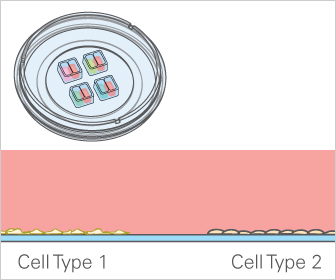
The ibidi Culture-Inserts enable different adherent cell populations to be seeded at defined positions within the same culture vessel. During cell attachment, the populations remain physically separated by the walls of the insert. After removing the Culture-Insert, a defined cell-free gap remains and the populations can migrate toward each other, interact, and eventually establish direct cell-cell contact.
This setup is particularly useful for investigating heterotypic cell interactions, migration fronts, invasion, and tumor-stroma interactions. The Culture-Insert 2 Well 24 transfers the same principle to a standardized 24-well format for experiments with multiple conditions or replicates.
Learn more about wound healing, migration, and invasion assays.
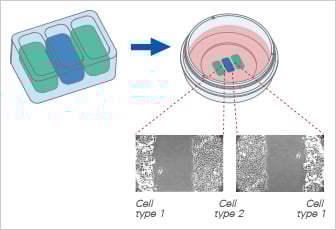
ibidi Products for Direct-Contact Co-Culture:
Protocol:
AN 77: Co-Culture Invasion Assay (PDF)
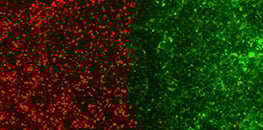
Co-culture invasion assay using the Culture-Insert 2 Well and fluorescently labeled cell populations.
Analyze Paracrine Signaling: Co-Culture Without Direct Cell-Cell Contact
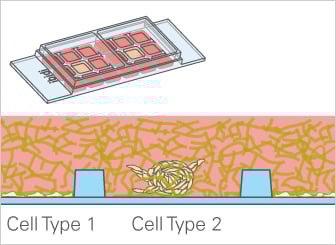
In indirect co-culture, different cell populations remain spatially separated but communicate through soluble factors in a shared medium. This approach is useful when direct cell-cell contact should be prevented while paracrine signaling between the populations is maintained.
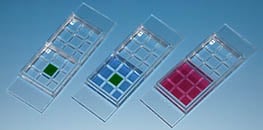
The µ-Slide 2 Well Co-Culture is specifically designed for this purpose. Recipient and feeder cells can first be seeded separately and, after cell attachment, connected through the shared culture medium. The slide can also be used to combine cells or spheroids embedded in gel matrices with feeder or supporting cells cultivated in neighboring wells.
ibidi Product for Indirect Co-Culture:
Protocol:
AN 10: Co-Cultivation (PDF)
Co-cultivation of different cell types in the µ-Slide 2 Well Co-Culture.
3D Co-Culture Models: Combining Multiple Cell Types in a Spatially Relevant Environment
Combining different cell types in 3D structures can reproduce important aspects of the in vivo cellular environment that are not represented by a single-cell-type monolayer. 3D co-culture models enable the analysis of cell-cell and cell-matrix interactions, paracrine signaling, chemotactic migration, transmigration, invasion, and penetration into extracellular matrices.
These approaches are particularly relevant for studying tumor microenvironments, tissue regeneration, disease models, and multicellular responses to drugs or other treatments. Spheroids and organoids can also be combined with stromal, endothelial, immune, or other supporting cell populations to create more complex in vitro models.
Because several cell populations must remain functional within the same experimental system, 3D co-culture assays generally require optimization of parameters such as cell ratios, seeding densities, culture medium, extracellular matrix composition, assay timing, and, where applicable, perfusion conditions.
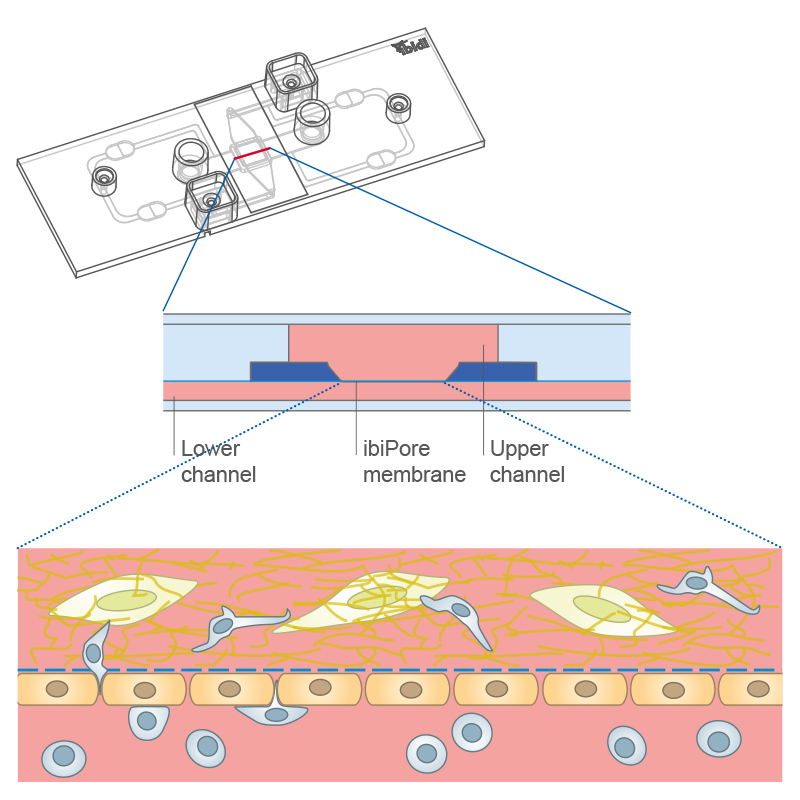
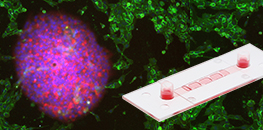
Transmigration of cells across a cell monolayer on the membrane into a 3D gel matrix with embedded cells using the µ-Slide ibiPore SiN.
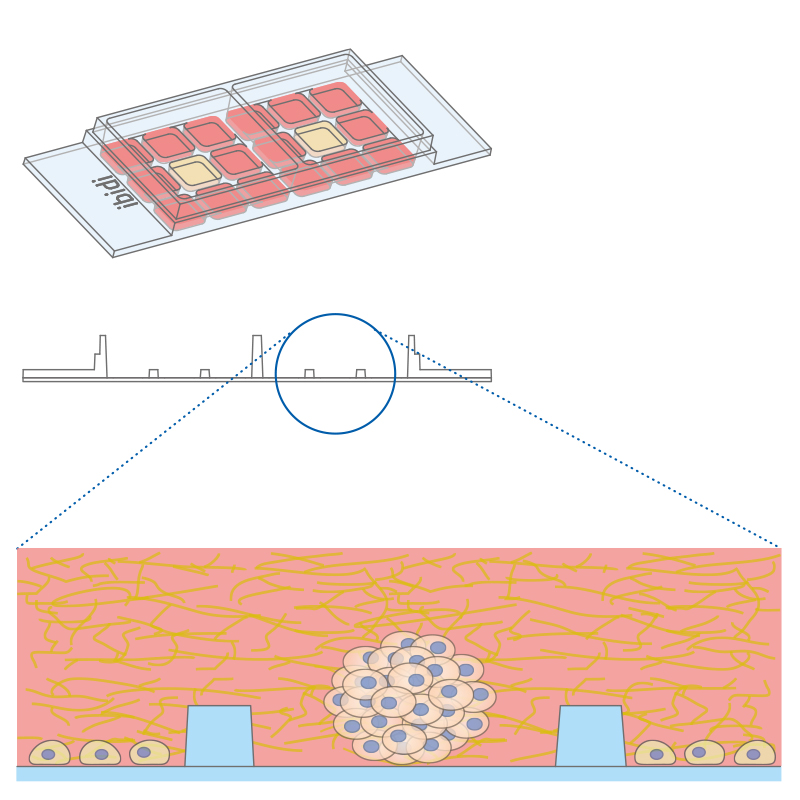
Co-cultivation of different cell types in a 3D matrix using the µ-Slide 2 Well Co-Culture.
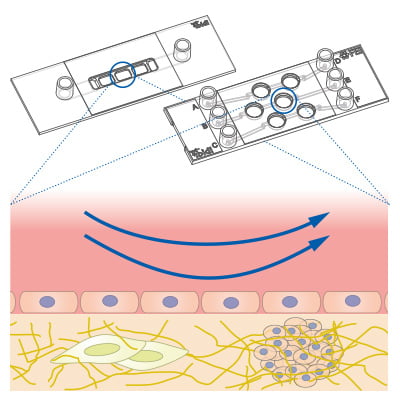
Cell and spheroid co-culture under flow on and inside a gel matrix using the µ-Slide I Luer 3D or µ-Slide III 3D Perfusion.
Membrane-Based and Membrane-Free Co-Culture Interfaces
Porous membranes allow different cell populations to be cultivated on opposite sides of the same membrane while soluble molecules can pass between the compartments. Depending on the pore size and assay design, cells can also migrate through the membrane. These systems are useful for barrier models, apical-basal organization, transport, epithelial-endothelial interactions, and transmigration assays.
The µ-Plate 24 Well for Membrane Inserts combines standard porous membrane inserts with direct microscopy access. It can be used for co-culture models in which, for example, epithelial and endothelial cells are cultured on opposite sides of a membrane.
The µ-Slide ibiPore SiN enables two cell populations to be cultivated on opposite sides of a porous membrane and can additionally combine a cell monolayer with cells embedded in a 3D gel matrix. This allows signaling, barrier, transport, transmigration, and 2D/3D co-culture experiments in the same platform.
The micro-Insert 3D provides a membrane-free alternative. A hydrogel forms the interface between defined compartments and can be accessed from both sides, enabling cell culture on or within the matrix while retaining direct microscopy access.
Matrix-Based Co-Culture With Cells, Spheroids, and Organoids
3D extracellular matrices make it possible to position different cell populations within, on top of, or adjacent to a gel. This spatial organization enables researchers to investigate how cells interact with each other and with their extracellular environment.
The µ-Slide 2 Well Co-Culture can combine spheroids or cells embedded in a gel matrix with feeder or supporting cells in neighboring wells while the populations share soluble factors.
The µ-Slide 15 Well 3D supports co-culture experiments in which one cell population is incorporated into a gel matrix and another population is seeded on the matrix. This can be used, for example, to investigate interactions between cancer cells and fibroblasts or invasion into an extracellular matrix.
For experiments requiring more parallel conditions, the µ-Plate 96 Well 3D supports matrix-based co-culture in a 96-well format. Cells such as fibroblasts can be embedded in a gel while another cell population, spheroids, or organoids are positioned on or within the matrix.
Collagen Type I can be used as a 3D extracellular matrix for many of these co-culture, invasion, and migration assays.
Chemotactic Interaction, Migration, and Transmigration Between Cell Populations
Co-culture systems can also be used to investigate directional communication between different cell populations. One population can release soluble factors that create a chemotactic gradient, while the migration of another population is analyzed in 2D or within a 3D extracellular matrix.
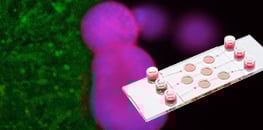
The µ-Slide Chemotaxis allows adherent chemoattractant-producing cells to be seeded in a reservoir while another cell population is monitored in the central observation area. The migrating cells can be cultured on a surface or embedded in a 3D gel matrix.
The sticky-Slide Chemotaxis uses the same chemotaxis geometry while allowing custom bottom materials. For transmigration across a cell monolayer or toward cells embedded in a 3D matrix, the µ-Slide ibiPore SiN provides a membrane-based approach.
The micro-Insert 3D provides an additional membrane-free setup for chemotaxis-driven invasion into a collagen matrix.
3D Co-Culture Under Flow
Combining 3D co-culture with controlled perfusion enables multicellular systems to be investigated under dynamic conditions. Depending on the setup, flow can provide continuous medium perfusion or expose a cell layer to defined wall shear stress while another cell population is embedded within a 3D extracellular matrix.
The µ-Slide I Luer 3D allows cells or spheroids to be embedded inside a gel matrix while an additional cell monolayer is cultivated on the gel surface and exposed to flow. This configuration can be used to investigate interactions between tumor spheroids and endothelial cells under perfusion.
The µ-Slide III 3D Perfusion provides three parallel channels for 3D matrices and enables spatially defined multicellular co-culture models under flow.
Both systems can be combined with the ibidi Pump System for controlled long-term perfusion.
Application Notes and User Protocols for Co-Culture
Frequently Asked Questions About Cell Co-Culture
What Is a Cell Co-Culture Assay?
A cell co-culture assay combines two or more cell populations within the same experimental system. Depending on the assay design, the populations can interact through direct cell-cell contact, soluble factors, a porous membrane, a 3D extracellular matrix, chemotactic gradients, or a combination of these mechanisms.
What Is the Difference Between Direct and Indirect Co-Culture?
In direct co-culture, different cell populations can physically contact each other. In indirect co-culture, the populations remain spatially separated but communicate through soluble factors. Culture-Inserts are suitable for spatially defined seeding followed by direct interaction, while the µ-Slide 2 Well Co-Culture keeps cell populations separated while allowing soluble-factor exchange through shared medium.
Which ibidi Product Allows Cells to Share Soluble Factors Without Direct Cell-Cell Contact?
The µ-Slide 2 Well Co-Culture allows different cell populations to remain spatially separated while sharing the same culture medium and exchanging soluble factors.
Can I Perform Co-Culture on Opposite Sides of a Membrane?
Yes. The µ-Plate 24 Well for Membrane Inserts can be used with porous membrane inserts to cultivate different cell populations on the apical and basal sides of a membrane. The µ-Slide ibiPore SiN also supports co-culture of cell layers on opposite sides of a porous membrane and can combine a cell monolayer with a 3D matrix.
Is Membrane-Free 3D Co-Culture Possible?
Yes. The micro-Insert 3D uses a hydrogel to create a cellular interface between different compartments without a rigid porous membrane. Cells can be cultured on or within the matrix while the gel remains accessible from both sides.
Can Spheroids or Organoids Be Used in Co-Culture?
Yes. Spheroids and organoids can be combined with stromal, endothelial, immune, feeder, or other supporting cell populations. Depending on the experimental design, suitable ibidi products include the µ-Slide 2 Well Co-Culture, µ-Slide 15 Well 3D, µ-Plate 96 Well 3D, µ-Slide I Luer 3D, and µ-Slide III 3D Perfusion.
Can One Cell Population Be Used as a Source of Chemoattractants for Another?
Yes. In the µ-Slide Chemotaxis, chemoattractant-producing cells can be cultured in one reservoir while migration of another cell population is monitored in the observation area. The migrating cells can be analyzed in 2D or embedded within a 3D gel matrix.
Can Co-Culture Assays Be Performed Under Flow?
Yes. The µ-Slide I Luer 3D and µ-Slide III 3D Perfusion enable multicellular 3D models to be combined with controlled perfusion. In combination with the ibidi Pump System, these setups can be used for long-term dynamic co-culture experiments and, depending on the configuration, defined wall shear stress.
Which Parameters Should Be Optimized for a 3D Co-Culture Assay?
3D co-culture assays require conditions that support all cell populations in the experiment. Important parameters include cell type and ratio, seeding density, sequence and timing of cell seeding, culture medium, extracellular matrix composition and concentration, incubation time, and the selected imaging readout. For co-culture under flow, flow rate and wall shear stress must also be adapted to the experimental model.
Can Co-Culture Be Used for Tumor-Immune Cell Assays?
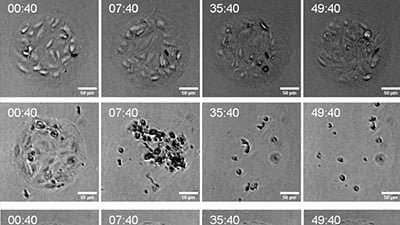
Yes. Direct co-culture can be used to investigate interactions between tumor and immune cells. Examples include live cell imaging of immunological synapse formation between antigen-presenting cells and T cells and time-lapse analysis of T cell-mediated tumor cell killing on the µ-Pattern ibiTreat.
Which Co-Culture Systems Are Suitable for Microscopy?
ibidi co-culture solutions are designed to combine cell culture with microscopic analysis. The optimal product depends on whether the experiment requires direct or indirect interaction, membrane-based separation, a 3D extracellular matrix, chemotactic migration, spheroids or organoids, or controlled flow.