



Three Outstanding PhD Researchers Honored with the Nano Innovation Award 2026
The LMU Center for NanoScience and four CeNS spin-off companies, including ibidi, recognize groundbreaking PhD research with exceptional innovation and translational potential.
Single-molecule microscopy, AI-powered nanomedicine, and light-controlled DNA nanostructures: The Nano Innovation Award 2026, presented by the Center for NanoScience (CeNS) at LMU Munich together with four CeNS spin-off companies, honors three outstanding PhD projects that demonstrate both scientific excellence and strong application potential in nanoscience.
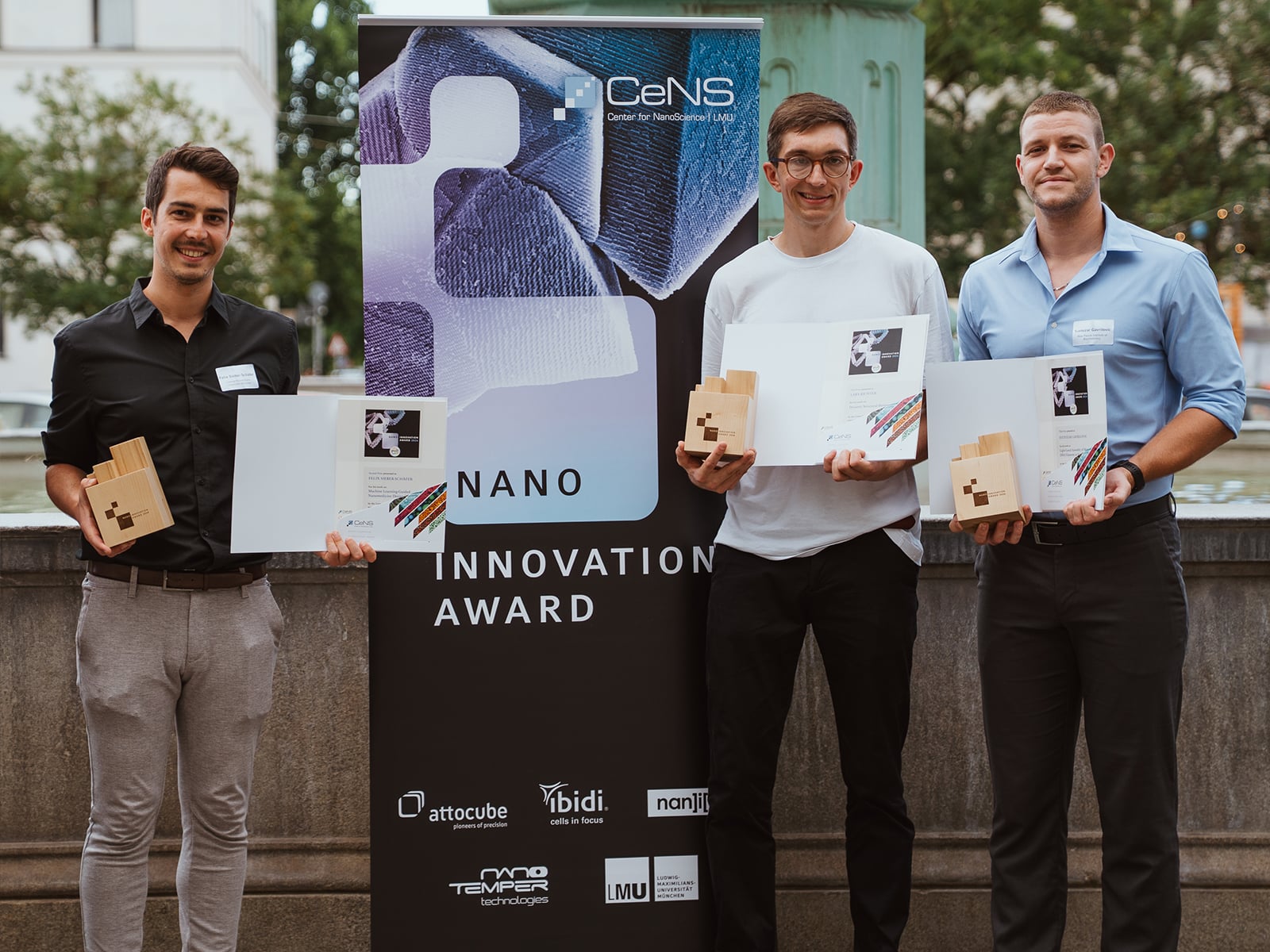
Winners of the Nano Innovation Award 2026
From left to right: Felix Sieber-Schäfer, Lars Richter, Svetozar Gavrilovic
This year's award recipients are Lars Richter (LMU Department of Chemistry), recognized for developing an innovative single-molecule microscopy approach; Felix Sieber-Schäfer (LMU Department of Pharmacy), honored for his AI-assisted design of RNA nanocarriers for therapeutic delivery; and Svetozar Gavrilovic (Max Planck Institute of Biochemistry), whose research focuses on light-controlled DNA structures for synthetic cell systems.
The CeNS Nano Innovation Award is presented annually to outstanding doctoral researchers in Bavaria whose work opens new avenues for addressing scientific and technological challenges. Beyond recognizing academic excellence, the award aims to encourage early-career scientists to identify and further develop the translational potential of their research.
Visualizing Biomolecular Dynamics at the Single-Molecule Level
As part of his doctoral research Dynamic Structural Biology with GETvNA, carried out in the research group of Professor Philip Tinnefeld, Lars Richter co-developed a novel single-molecule microscopy platform based on DNA nanotechnology. The method arranges DNA strands vertically on graphene,an atomically thin carbon material,and uses fluorescence measurements to monitor dynamic structural changes in DNA and DNA–protein complexes. This enables researchers to observe molecular motion and conformational changes with exceptional spatial and temporal resolution, providing new opportunities for studying fundamental biological processes.
Accelerating RNA Nanocarrier Design with Artificial Intelligence
In his PhD project Machine Learning-Enhanced Molecular Dynamics for the Prediction and Optimization of RNA Nanocarrier Systems, conducted in the research group of Professor Olivia Merkel, Felix Sieber-Schäfer developed data-driven strategies for designing RNA delivery systems. By integrating machine learning, molecular dynamics simulations, and experimental formulation studies, he established a more systematic approach for identifying promising lipid- and polymer-based nanoparticles. His work aims to replace time-consuming trial-and-error development with predictive, data-supported design, helping to accelerate the development of next-generation RNA therapeutics.
Light-Controlled DNA Assembly for Synthetic Cell Systems
Working in the research group of Professor Petra Schwille, Svetozar Gavrilovic developed a platform for the light-controlled assembly of DNA nanostructures on artificial membranes in his doctoral thesis Light-Gated Assembly of Membrane-Bound DNA Filaments as Synthetic Cell Modules. The approach employs DNA building blocks that become activated only upon exposure to UV light, allowing researchers to precisely control where and when DNA structures form. This technology provides a powerful tool for recreating and studying membrane-associated biological processes and could ultimately contribute to the development of synthetic cells and advanced biomimetic materials.
All three award recipients conduct their research within laboratories that are part of the CeNS network.
The Nano Innovation Award 2026 is presented by the Center for NanoScience (CeNS) in cooperation with the CeNS spin-offs attocube systems, ibidi, Nanion Technologies, and NanoTemper Technologies. The four companies sponsor prize money of €4,000, €3,000, and €2,000 for first, second, and third place, respectively.
The awards were presented on July 17, 2026, during the “CeNS meets Industry” career event at the Faculty of Physics, LMU Munich.